.@RandPaul was once labeled a “conspiracy theorist” for saying a lab leak probably caused Covid.
Now the FBI and Energy Department say it's likely.
Here he explains how Anthony Fauci and other officials tried to COVER UP the origin to protect their reputations and funding: pic.twitter.com/DTMKlRYMPA
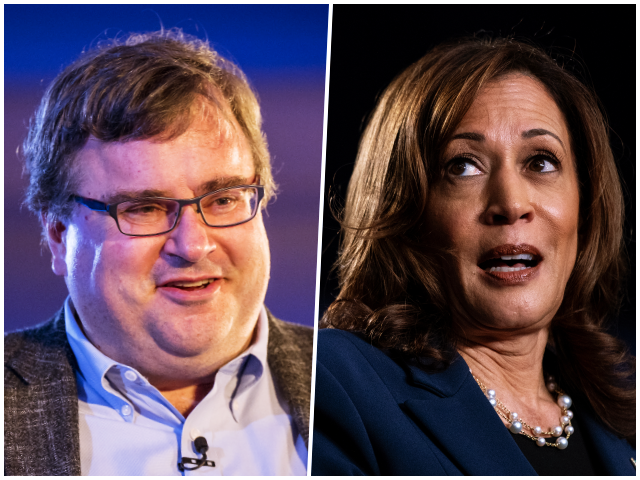
Tech billionaire Reid Hoffman, who once visited
Jeffrey Epstein’s private island, is bundling millions of campaign
donations from Silicon Valley giants for Vice President Kamala Harris’s
presidential bid. With those donations comes some demands, requests for
Harris to fire the nation’s top trust-buster Lina Khan from the Federal
Trade Commission (FTC) while also throwing out United States tariffs on
foreign imports.
Hoffman, the co-founder of LinkedIn and a top Democratic Party donor, is reportedly set to bundle some $100 million from elites in Silicon Valley for Harris’s presidential run.
In an interview
with CNN, Hoffman suggested he wants Harris to return the U.S. to a
free trade consensus that has ruled in Washington, DC, for decades —
resulting in the loss of millions of American jobs, particularly in the
manufacturing sector.
Hoffman said he and other billionaire donors are
unbothered by President Joe Biden and Harris’s push to raise corporate
taxes because the impact would be minuscule.
“Trump wants tariffs which is anti-business … makes this a very
strange election indeed because I think actually Vice President Harris
is much more of the pro-business candidate than Trump and Vance,”
Hoffman told CNN:
I think what’s most important for business is stability of the country, unity, rule of law. And a percent difference in corporate tax … is far, far less important. [Emphasis added]
Former President Donald Trump has said he wants to see
across-the-board tariffs on particularly Chinese imports to reshore
manufacturing back to the U.S.
CNN reporter Matt Egan said Hoffman also mentioned that he wants FTC
Chair Lina Khan, the nation’s top trust-buster, fired under a potential
Harris administration.
“In particular, he strongly criticized Lina Khan, the FTC chair. He
said that Lina Khan is ‘waging war on American business’ and he went so
far as to say that he hopes that a President Harris would replace Lina
Khan at the FTC,” Egan reported.
Hoffman, for years, has made clear he opposes efforts to break up Big Tech corporations and rigorous antitrust enforcement.
“The notion of ‘Oh, we should be breaking up these companies’ is bad
from an innovation standpoint … so that’s part of the reason why I [want
to] shape and make it as good outcomes for society but not an antitrust
action,” Hoffman told the Washington Post in 2021.
The New York Timesreported that Harris may already be caving to big donor requests, such as those from Hoffman, regarding Khan’s role at the FTC:
Business leaders have also bristled at the actions of the Federal Trade Commission’s chair, Lina Khan, who has tried to crack down on corporate mergers. [Emphasis added]
As vice president, Ms. Harris has voiced support for regulating artificial intelligence. But she
has expressed skepticism of Ms. Khan’s expansive view of antitrust
powers, according to a donor who has spoken privately with the vice
president. [Emphasis added]
Khan has won praise from former President Donald Trump’s running
mate, Sen. JD Vance (R-OH), as well as other conservatives such as Rep.
Matt Gaetz (R-FL), Rep. Ken Buck (R-CO), and Sen. Josh Hawley (R-MO) for
her seeking to break up Big Tech, corporate monopolies, and eliminate
noncompete agreements for employees.
Federal
Trade Commission Chair Lina Khan prepares to testify before the House
Judiciary Committee in the Rayburn House Office Building on Capitol Hill
on July 13, 2023, in Washington, DC. (Chip Somodevilla/Getty Images)
In a recent Wall Street Journalprofile
of Khan, the paper coined such Khan supporters “Khanservative
Republicans” — a nod to the party’s populist-nationalist wing that wants
to see a crackdown on the monopolistic power that multinational
corporations have in the U.S. economy.
“I look at Lina Khan as one of the few people in the
Biden administration that I think is doing a pretty good job,” Vance
said a few months ago of Khan’s record as FTC chair.
Gaetz interviewed Khan in August 2023 for Newsmax where he praised
her efforts to crack down on what he said are abuses by Big Tech
corporations against American consumers and smaller businesses.
Khan told Gaetz of her views on monopoly power:
When we think about issues relating to
concentration of power, and in the same ways that you don’t want a
concentration of power in the political sphere, Congress passed the
antitrust and anti-monopoly laws to make sure that we had
decentralization and competition in our commercial sphere so
that any decision that any one person made, it wasn’t affecting whether
people could be seen or heard in the marketplace of ideas. And so we
think that robust competition is a key way to fight censorship, is a key way to make sure that people have more choice in the marketplace. [Emphasis added]
The Wall Street Journal editorial board has seethed over Hawley’s support for Khan at the FTC, publishing two editorials portraying both officials as anti-business.
Hawley was a leading voice in the Senate among Republicans opposing non-compete agreements from employers. Khan has since turned Hawley’s complaints about non-competes into action, issuing a regulation to ban such agreements by employers on their employees.
This week, a federal judge upheld the FTC’s ban on non-compete agreements in a major judicial win for Khan. [SOURCE]
"For god's sake, stop complying. Start rebelling. They are out to get you if you do not resist."
German MEP Christine Anderson: The "so-called pandemic" was a beta test, conducted to determine how easy it would be to seize complete totalitarian control, under the pretext of a… pic.twitter.com/v6hHPbWKt8
The Justice Department has agreed to pay $1.2 million to settle
privacy-invasion claims from Peter Strzok, seen here at a 2018 House hearing. Manuel Balce Ceneta/AP
The
Justice Department has agreed to pay a total of $2 million to settle
legal claims brought by former FBI counterintelligence agent Peter
Strzok and former FBI attorney Lisa Page over the DOJ’s release of text
messages the pair exchanged.
The agreement ends a lawsuit Page
brought, but does not fully resolve Strzok’s separate suit, allowing him
to continue to press his claims that he was fired in order to please
then-President Donald Trump.
On Friday, Strzok’s lawyers announced
his $1.2 million agreement as attorneys for both sides notified a
federal judge in Washington that the privacy-focused portion of that
dispute was resolved.
“This
outcome is a critical step forward in addressing the government’s
unfair and highly politicized treatment of Pete,” Strzok attorney Aitan
Goelman said in a statement. “As important as it is for him, it also
vindicates the privacy interests of all government employees. We will
continue to litigate Pete’s constitutional claims to ensure that, in the
future, public servants are protected from adverse employment actions
motivated by partisan politics.”
Page,
who resigned amid the controversy, settled her own Privacy Act claim
with the department Friday. Copies of the settlement agreements for Strzokand Page
obtained by POLITICO indicate Page is to receive $800,000. The
documents state that the U.S. government is not admitting or conceding
legal liability.
“The
evidence was overwhelming that the release of text messages to the
press in December 2017 was for partisan political purposes and was
against the law,” Page’s lawyer, Amy Jeffress, said in a statement.
“While
I have been vindicated by this result, my fervent hope remains that our
institutions of justice will never again play politics with the lives
of their employees,” Page added.
Strzok
and Page became the target of Trump’s fury soon after the texts became
public, showing the two officials disparaging Trump and his supporters.
The pair discussed efforts to “stop” Trump from becoming president and
characterized aspects of their work as an “insurance policy.”
Trump
also harbored suspicion about the two because of their roles in the
early stages of the FBI’s investigation into his 2016 presidential
campaign’s links to Russia. Trump spent years mocking Strzok and Page in
crude terms over their relationship and contending their text messages
bolstered claims that the Russia investigation was politically
motivated.
Strzok and Page have denied those
allegations, saying their private political opinions did not influence
their work on FBI matters, and many comments quoted by GOP lawmakers and
the press were misconstrued.
During a House hearing in 2018,
Strzok said the message about stopping Trump “was written late at
night, off-the-cuff, and it was in response to a series of events that
included then-candidate Trump insulting the immigrant family of a fallen
war hero, and my presumption, based on that horrible, disgusting
behavior that the American population would not elect somebody
demonstrating that behavior to be president of the United States.”
Depositions taken during the
litigation indicated the release was approved by Deputy Attorney General
Rod Rosenstein, who said he hoped sharing the messages with reporters
would avoid the most inflammatory messages being taken out of context by
lawmakers. Top career officials confirmed they approved the release.
Rosenstein declined to comment on the settlements Friday.
A Justice Department spokesperson declined to comment on why the agency agreed to the payments.
However, at a House hearing last
month, following indications that tentative settlements had been
reached, Republicans pressed Attorney General Merrick Garland about why
taxpayer money was going to flow to Strzok and Page.
“We reached settlements based on our
litigators’ assessment of whether we can win the case and how much it
will cost if we lose the case,” Garland said. “The Privacy Act doesn’t
distinguish between people we like and people we don’t like, information
we like and information we don’t like. If somebody in the government
discloses personal information protected by the Privacy Act, that’s the
way the law is.”
“So, you can go after a president and
you get rewarded for doing so, according to the Justice Department?”
House Judiciary Chair Jim Jordan (R-Ohio) replied.
“It’s not a question of reward. It’s a question of the government paying for violating the law,” Garland answered.
The partial settlement in Strzok’s
suit contains a provision that any damages he may be awarded in the
remaining part of his lawsuit will be reduced by $200,000 as a result of
the $1.2 million payment he is to receive. Neither Page nor Strzok can
seek an additional award of legal fees for the claims settled Friday. [SOURCE]
An
Arizona company that manufactures and operates high-altitude
surveillance balloons, and contracts with the federal government, faces renewedattentionin the aftermath of the destruction of a spy balloon sent by the Chinese government that entered U.S. airspace earlier this month.
As recently as seven years ago, the company secured funds from Chinese investors.
Context:
Tucson-based World View, cofounded by now-U.S. Sen. Mark Kelly in 2012,
received venture capital from Tencent — among the largest tech
companies in China — both in 2013 and 2016.
Tencent, like most Chinese tech giants, has close ties to the Chinese Communist Party.
Yes, but: World View president and CEO Ryan Hartman told The Arizona Republic in 2020 that Tencent had "zero access, zero input and zero control" over the company.
Of note: When Tencent made its investments, World View was mostly focused on space tourism. Tencent says it stopped investing after the Arizona company pivoted to a defense-oriented business.
Today, World View contracts with the U.S. government and private companies to provide aerial surveillance via balloon.
About 65% of the company's work last year was "defense related," Hartman told Breaking Defense.
The
Pentagon's Defense Counterintelligence Security Agency examined World
View in 2019 and cleared the company to handle military work, The
Republic reported.
State of play: A high-altitude balloon sent by the Chinese government was downed
by an American fighter aircraft off the coast of South Carolina in
early February. The U.S. government believes it was being used for surveillance purposes.
Why it matters: That event escalated tensions between the U.S. and China and raised concerns over Chinese governmentsurveillance and influence in American businesses.
Claire Chu, senior China analyst at defense intelligence company Janes,
tells Axios Phoenix the balloon provides an opportunity to more
carefully examine Chinese holdings in critical U.S. industries,
including Tencent's investment in World View.
"It's just not a
good look to have one of the largest Chinese investors, a Chinese
company that's involved in a lot of critical technologies back home,
involved in potential U.S. surveillance capabilities here," she says.
What they're saying:
National security and global economic experts told us Tencent's
investment in World View was "odd" but not necessarily cause for
concern.
American Enterprise Institute researcher Derek
Scissors tells us many Chinese companies invested in seemingly random
U.S. entertainment and tourism businesses around 2016 in an attempt to
move money out of China.
"We have a very small stake in the
company, with no board seat or investment rights," Tencent said in a
statement to Axios. "We invested when the business model focused on
space tourism. Once the business shifted, we stopped investing and no
longer have any active communications with the company."
Photo: Courtesy of World View EnterprisesMark Kelly speaks during a campaign event in Phoenix on Nov. 2. Photo: Patrick T. Fallon/AFP via Getty Images
Zoom out: Kelly stopped working with World View in 2019, ahead of his first Senate run.
"As
a combat veteran, he's proud of the critical role that Arizona plays in
developing technologies in partnership with our military to keep our
country safe," Jacob Peters, a spokesperson for Kelly, told us of the
senator's involvement.
Flashback: In 2014, former World View CEO Jane Poynter told Chinese news outlet Pengpai
that Kelly met with Tencent USA head David Wallerstein and "introduced
space tourism technology to him," Poynter said. "David was very
interested and willing to invest at this stage" after speaking with
Kelly, according to the article translated from Chinese.
In
2020, Kelly told The Arizona Republic, "I had a very brief conversation
with one individual [from Tencent] that lasted about 30 seconds, maybe a
minute.”
The big picture:
Chinese investment in the U.S. exploded in 2016, after the Chinese
government allowed its businesses to seek more outside investments, Mark
Witzke of Rhodium Group tells Axios.
Investment dropped again in 2018 after China reversed its policies, the U.S. increased regulation of international investment and the geopolitical relationship between the two countries grew strained.
By the numbers: Chinese
companies invested more than $85 billion in American businesses between
2016 and 2017, more than the previous 15 years combined, per Rhodium
Group data. Fast-forward and investments dropped as low as $5.8 billion
in 2021.
Reality check: These numbers are
low, including only transactions in which a Chinese company took at
least a 10% stake in a U.S. company. Many smaller investments are kept
private.
For instance, Tencent's World View investments are not
included in these numbers and became known only because the companies
willingly disclosed the partnership.
Zoom in: Tencent
began investing in U.S. companies before 2016, acquiring
California-based esports company Riot Games in 2011, and has continued
to invest even after regulatory crackdowns.
It's one of the largest Chinese venture capital investors in U.S. companies, according to a 2020 Rhodium Group report.
But, but, but:
Scrutiny of Tencent's prolific investing, especially as it pertains to
national security infrastructure, is not without merit, Chu said.
What to watch: Last month, World View entered into a reverse merger agreement that'll allow it to go public with an estimated enterprise value of $350 million.
As
such, it will be required to reveal more information about its
investors, but won't necessarily have to share details about past deals,
like the one with Tencent, Scissors noted. [SOURCE]
Just your average Zen Baptist, admitting upfront to being a (mostly) reconstructed hillbilly.
If you can't understand the attitude or perspective I come from, it's safe to say that we're from different realities.
If you can't start off the conversation with a respectful question about how/why I came to the particular perspective I did, and then find some way that you can relate to it, then I don't have any time to entertain your issues.
Give respect, get respect.
Joe Glass Just Penelope – ’s No Wonder”
-
Real Sharp Pins heads may recall that Kai Slater self-released the
project's breakthrough album *Radio DDR* on Bandcamp in 2024 before the K
Records impr...
Hear Together: Roanoke Outside Foundation
-
Roanoke Outside is a nonprofit working to protect outdoor experiences and
build a stronger outdoor community. One of the biggest ways they do that is
thr...
Joe Shields - Brooklyn Bridge
-
Joe Shields - Brooklyn Bridge
Website - http://twoshacks.com.
From: joecartoondotcom
Views: 4343
203 ratings
Time: 03:55 More in Music